In this and the next few albums, we will
continue our tour along the Stachekavenue, which
we didn't get a chance to finish last
time, at the Park January 9th.
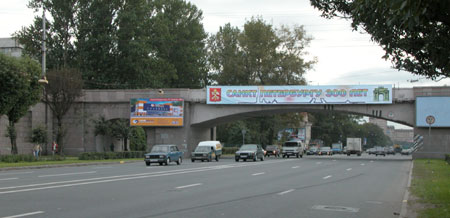
This time we will walk all the way toAvtovo metro
station, and even a little bit farther, so we can take a look
at the newly built viaduct.
The majority of the buildings in this
area are residential; roughly, theywere built
between 1930 and 1950. Speaking in politically correct terms -thisis the period of Neoclassicism, it is
also known as "Stalin's empire"
The general scheme of the Stachek
avenue was designed by an architectL.Ilyinm,who at the time was the chief architect of Leningrad. N. Trotskyoffered analternate plan for the
development of the avenue, but it wasrejectedbecause it suggested a complete overturn of the existing
district.
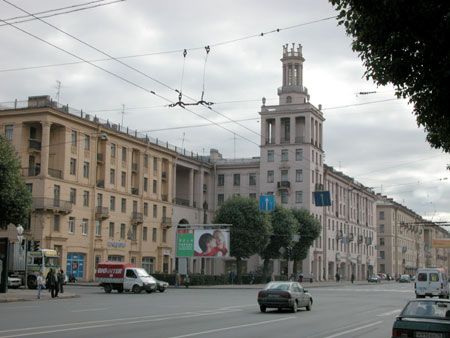
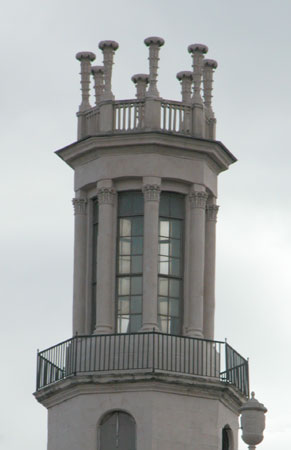
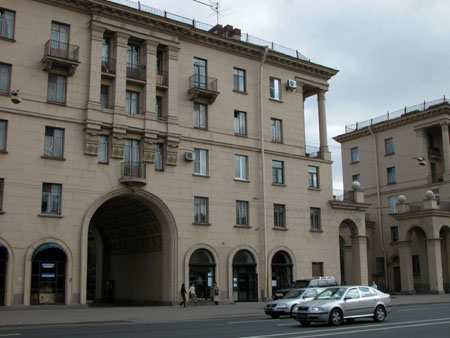
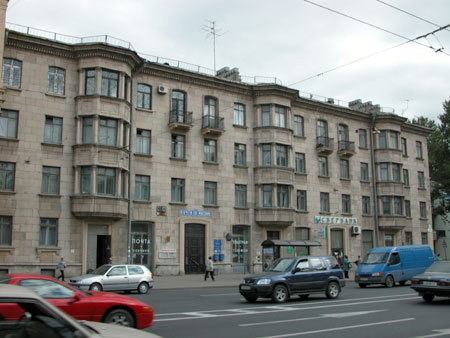
These two houses on the left (26 and 28) were designed by
V.A.Kamenskii. Inparticular, the one with a
tower was designed togetherwith A.V.Mondzalevkii and was built in 1950's.
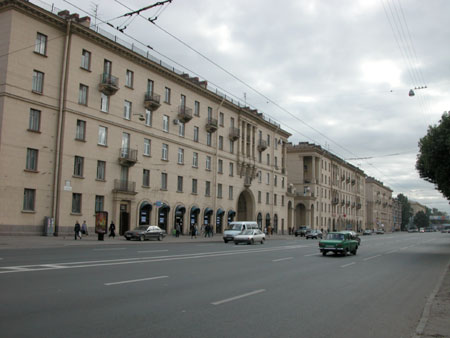
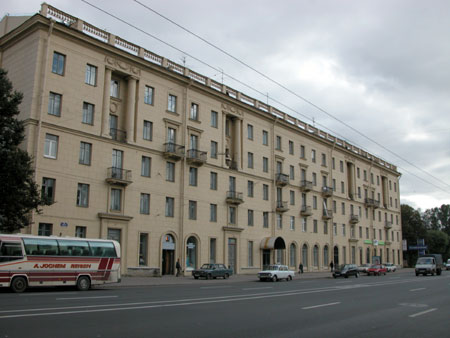
Here we can see three same-style houses
32, 34, 36.
They were designed bythree female architects:
G.L. Ashrapyan, O.S.Yakovleva and V.A.
Kardakova.Before these houses were established,
there was a side-walk of the Stachekavenue on
that same place, i.e. thestreet was wider
before, than it is now.
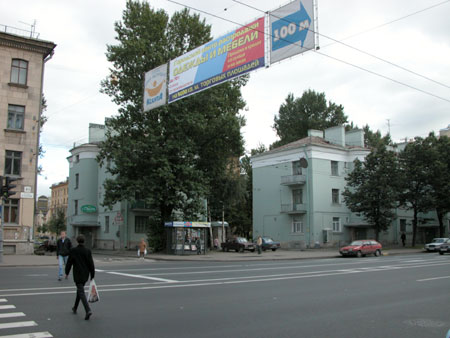
School #30, some other buildingthat was built
at about the same time, andsome houses from
earlier in thecentury look as if they are hidden
behind,because of the three houses.
Building #32 up-close.
Since back then, designers and architects aimed towiden the streets,rather then narrow them
down, one can conclude that inthis way theyconsciously tried to break down "the display of foreignconstructivism".
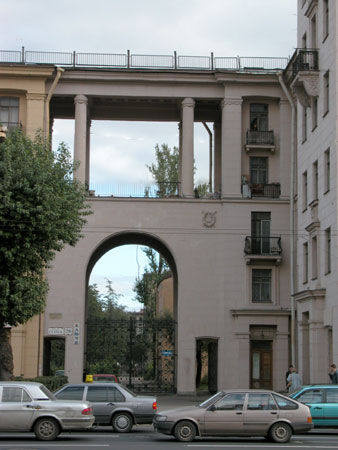
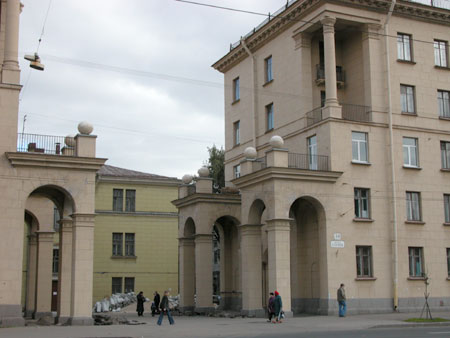
Building #34 - on the right.
The arches
that are attached on the sides of the buildings are images of thetendency of that time's architecture, which can be outlined this
way: "thebuildings are ought to be spatially
connected with each other". There wereopponents
to this point of view, who said that there's no need to build thearches and to waist scarce materials.
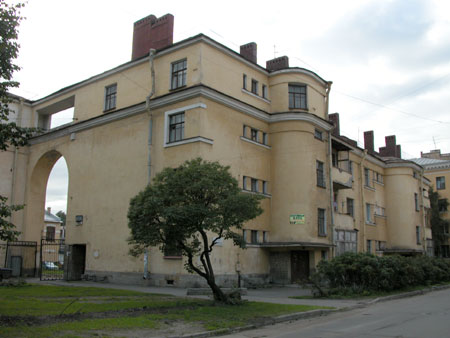
On the other side of the street there's a building #33.
This is an
earlier construction, it was built in 1920's and the style isconstructivism. The architects are A.S. Nikolski, A.I.Gheghello,D.L.krichevski, G.A.Simonov.
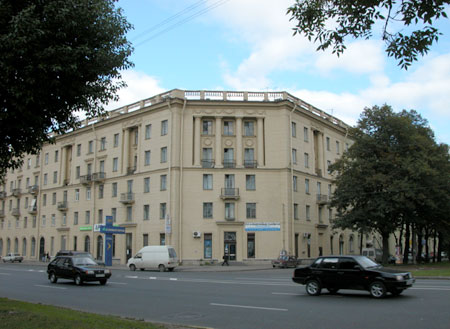
The corner of Stachek avenue and Ogorodni cross street. There's a house#42on the right. It was designed by the
same architects and was built atthesame time.
Historically speaking, this place is called
"Seraphimovski site".
House #40.
As I was suggested, this is a building of 1950's, because
only at this timewe are starting to have ceramic
slabs on the fronts of the buildings andonly at
this time the sizes of the windows are beginning to standardize.(here we can see the typical window size, that was used for
building later,at Stalin's time, and had a
serial number of 1-405).
House #46. The architect is V.A.Kamenski,
whom I had mentionedabove
already.
Same house, but from a different
perspective.
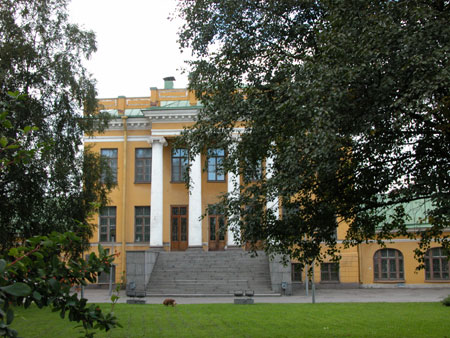
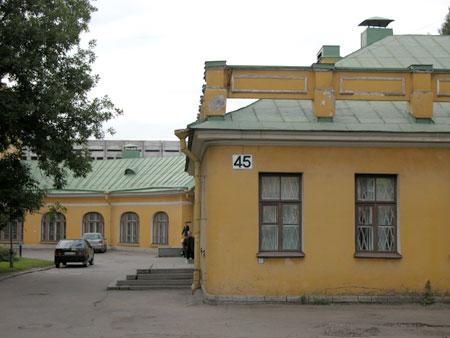
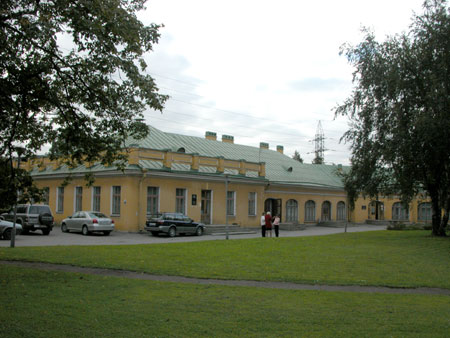
This building is much older than we've
seen before, #45.
It is known as a country-estate "Kir'yanovo" (before
it was called "Kir i
Ioannovo")
Apparently, it was a built according to the scheme by D.Kvarenghi in1783-1784.
The owner of the estate was princess E.R.Dashkova. She was thepresident ofboth Russian Academy of
Sciences and The Academy ofSciences ofSt.-Petersburg.
There's an unauthorized version, that the
estate was built according to herown scheme.
Since 1975 this estate functions as a Palace for Nuptials.
There used to be a park behind the
estate, but it did not live long enoughfor us to
see (it was destroyed in the early 19th century).
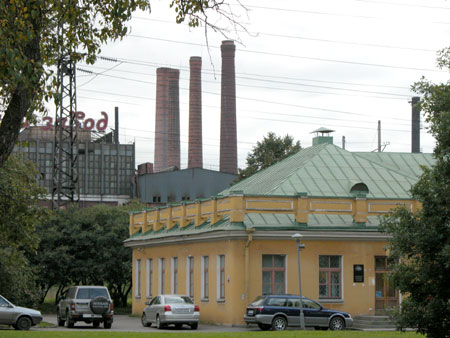
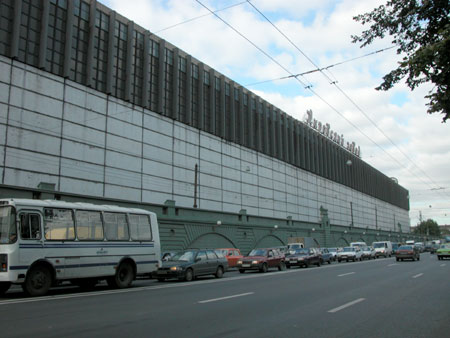
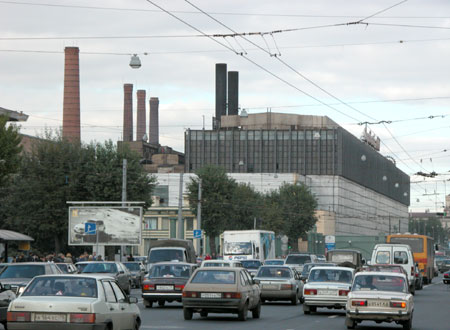
On the left youcan see the a few buildings of
Kirovski factory.
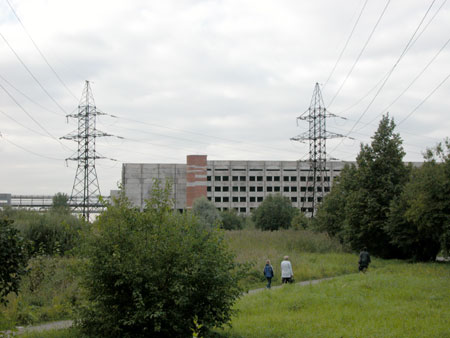
In front of the factory there are "new" buildings of the factory, theconstruction of which was aborted during perestroika.
In 1870's there was a Putilovskaya railway which was connectingKirovskifactory with other factories of
the city and with the primary thoroughfares.
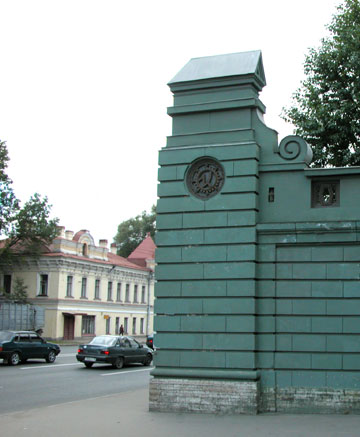
This is the beginning of the Kirovski factory, which occupies a vastterritory- as far as the Ekateringhovka
River.
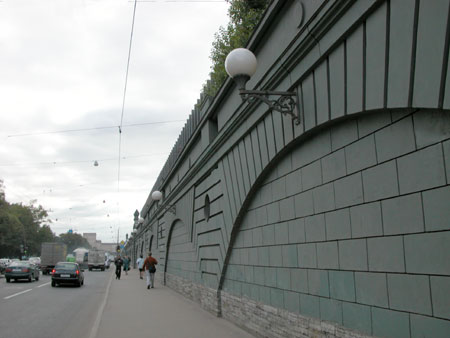
The fence, presumably, was built in 1950's.
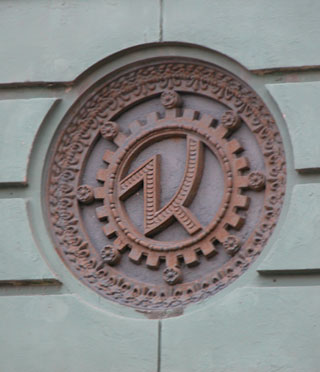
This is the emblem of this factory -
letter "K" in the center of agear-wheel.
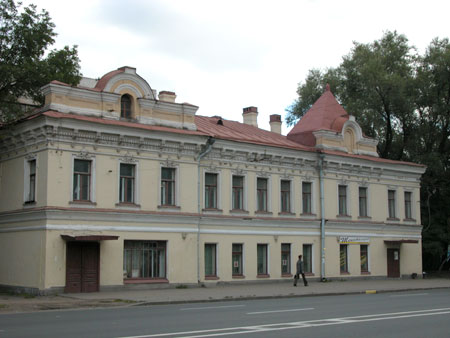
A little deviation from the factory theme
- right across the street there isan old
building #48, the building of Mr.Boghomolov, 1872)
Coming back to the factory...
Since
1801, cast iron industry was using the territory (it was moved fromKronshtadt). Starting in 1868, it was renamed as "Putilovski",
since theowner was N.I.Putilov. By the end of
the 19th century this factory was thebiggest
metallurgical factory in Russia.
Therefore, the number of workers employed was big.
During the revolutions of 1905-1917, they played an important role in
therevolutionary movement. Starting in October
1917, they were assemblingarmoured trains to
protect Petrograd (St.-Petersburg) from "White
Guards".
Skipping a little bit further into the century (next album) - the
commissarofthat armoured
train, which was assembled in October was I.I.Ghaza - oneof the workers of Putilovski factory).
On December 27, 1917 the factory was
nationalized and starting in 1922itwas renamed "Krasni Putilovets" ("Red Putilovets"). From this
time ontheyproduced
metal ware for Volhovskaya hydroelectric power station.In 1923-1924 they started to produce tractors
"Fordzone-putilovets" forthefirst time in USSR.
In 1930's - hoisting cranes, train cars, train bays.
In 1934 the
factory was renamed Kirovski again, in the memory ofS.M.Kirov.
During the war the factory was partially moved to Ural.
After the war they started to produce turbines for atomic-poweredvessels,landrovers, tractors "Kirovets",
and of course, tanks.
If we take into consideration what we
hear from people in publicsvehicles,and what we hear from friends, we can conclude that prsently thefactoryalmost doesn't function.
Of
course, no one is planning to close the factory down, considering thenumber of workers employed by the factory.
Nominally, the factory isnow open joint-stock
company.
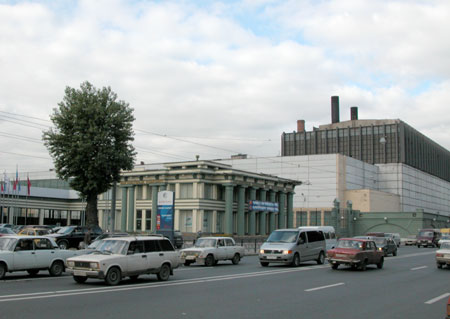
Show-room of the Kirovski factory.
It
was constructed in front of the entrace check-point in 1999-2000.
I should take a note, that it inscribed rather well into the scheme
of thearea... Even though, other opinions exist
:)
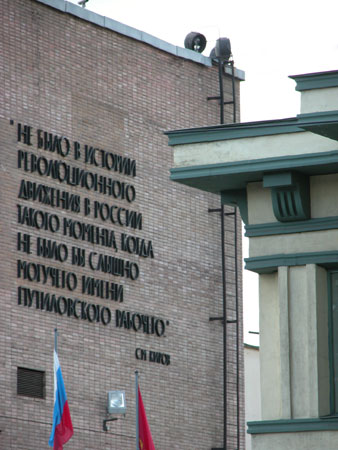
"There was no time in the history of
revolutionry movement in Russia, whenthe name of
the mighty putilovski worker was not heard".
S.M.Kirov
The Stachek avenue is now a very busy
street. In addition, in some placesit is clearly
felt that there are some ecological problems, because of the exhaust
gases of the cars.
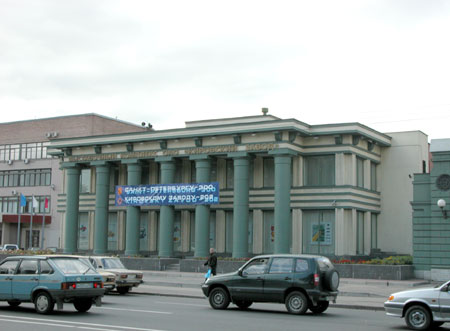
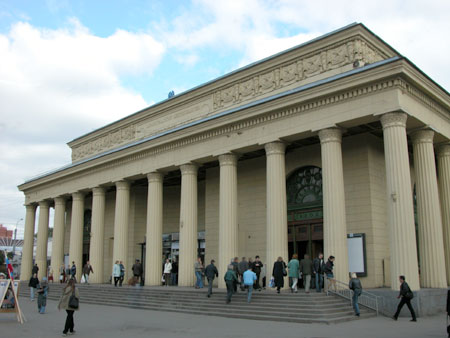
Metro station "Kirovski
Zavod" ("Kirovski Factory").
This building
somewhat reminds one of the most popular buildings in USA
-memorial of
Lincoln in Washington (it is pictured on a five-dollar bill). It
is being known, that originally in the space between the entrance and the
exit, there was supposed to be statue (talhough, not in sitting
position,likeLinclon's).
If anyone at the time would pay attention to this
building and drawparallels to the memorial in
USA, then the life of the architect could have
mysteriously been ended :)
The station was opened for public use in
1955, it was built according to the plan by A.K.Andreev.
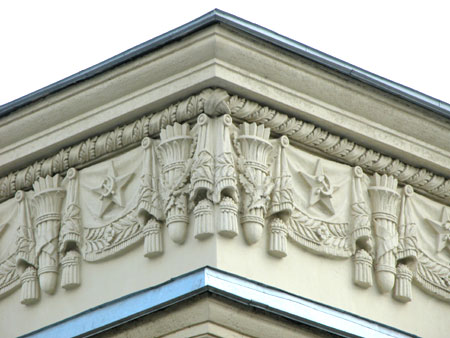
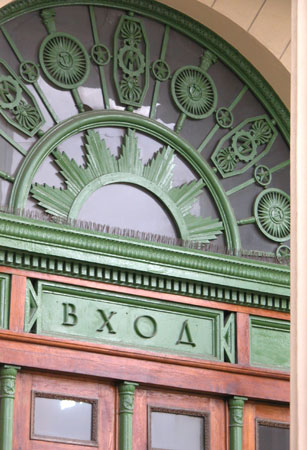
If we pay attention to the doors and
windows, we can see some similarities in decoration with metro station "Narvskaya",
although the two buildings are entirely different.