PUBLIC BUILDINGS 1703-1840. (Translated by
Andrei Frizyuk)
Right after the city's foundation, during the first
third of the 18th century, the most significant buildings were executed in
the 'Petrine baroque' style imported from Holland.
The Muscovite (or Elizabethan) baroque was popular
during the 20 years of Elizabeth's reign.
Still later, during Catherine II's reign, Scottish
architects introduced the Neoclassical trends into St.Petersburg
architecture. The 19th-century High Neoclassicism was known under the name
of the Empire style.
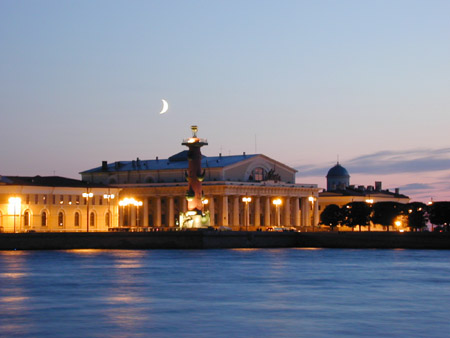
The Bourse
The edifice was
erected in 1805-10 to house a stock exchange. Since 1939 it has been a
home to the Central Naval Museum.
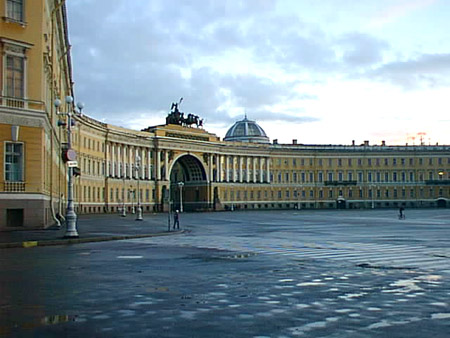
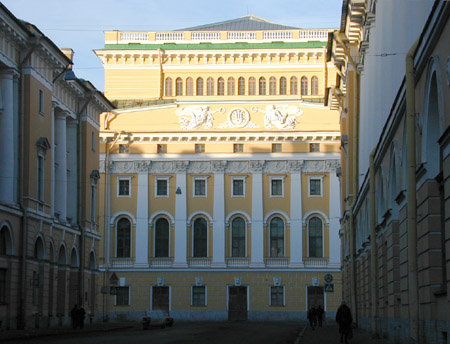
Apart
from the General Staff, the building used to house the Foreign Office
and the Ministry of Finance. After the revolution the right half of the
building was assigned to the General Staff Academy, the left half - to
the Hermitage museum. The whole complex was constructed in 1820-27 to a
design by Carlo Rossi.
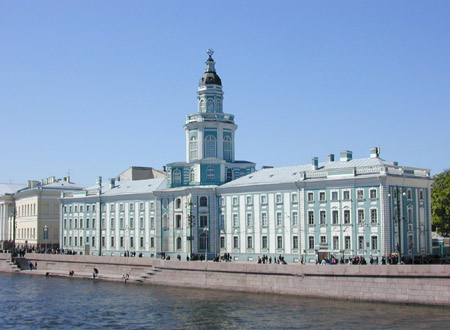
The Kunstkammer
(dating back to 1718-34) housed the Imperial Academy of Sciences,
libraries, observatories, and the first public museum in Russia. Today
the building is shared by two museums: the Lomonosov Memorial Museum and
the Peter the Great Museum of Anthropology and Ethnography.
The edifice
was built in 1764-88 to a design by Jean-Baptiste Vallin de la Mothe and
Alexander F. Kokorinov. In front of the building is a quayside decorated
with griffins and sphinxes.
Style: Early Neoclassicism
Address: Universitetskaya Embankment, 17
Nearest metro station: Vasileostrovskaya
Location:
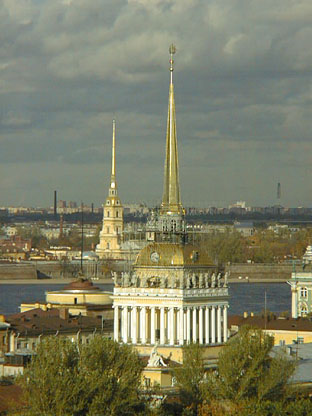
The Admiralty
The complex
(constructed in 1806-23) consists of the building, the central tower
crowned with a golden ship (used to be Leningrad's emblem), and two
pavilions on each side.
The Admiralty tower is the focal point of three radiating
thoroughfares: the Nevsky avenue, the Voznesensky avenue, and the
Gorokhovaya street.
The complex has been occupied by the Dzerjinka Naval School since
1925.
Architect: Adrian D. Zakharov
Style: the Empire style
Address: Admiralteisky passage, 1
Nearest metro station: Gostinyi dvor
Location:
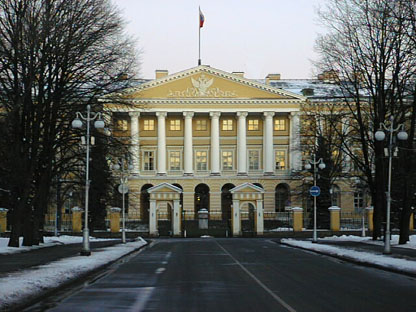
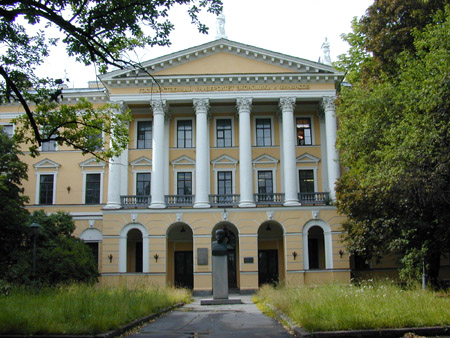
The Smolny Institute
The mansion by Giacomo Quarenghi
originally housed "the Society for Education of Noble Maidens" - the
first educational institution for Russian women. The Petrograd Soviet
and the Central Executional Committee were transferred here in 1917. The
Smolny has been especially notorious as the head-quarters of Bolshevik
organizations which planned and commanded the October revolution.
Style: High Neo-classicism
Address: Smolny passage
Nearest metro station: Tchernyshevskaya
Location:
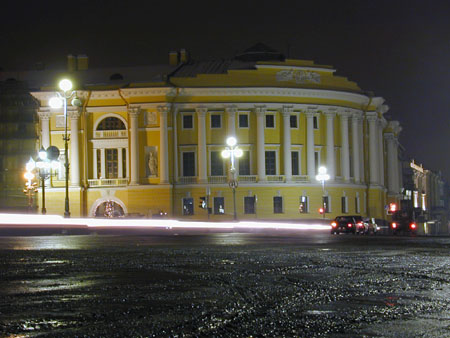
The Alexandrine Theatre
The
theatre, built in 1828-32 by Carlo Rossi, was named after the wife of
Nicholas I. It has been known as the Pushkin Academic Theatre of Drama
in the years following the October revolution.
Style: Neo-Classicism
Address: Ostrovsky Sq., 2
Nearest metro station: Gostinyi dvor
Location:
The Senate and Synod buildings
Upon completion of the construction works in 1843, there used to sit
supreme imperial institutions of secular and ecclesiastical power. After
the revolution the building passed to the Central Historical Archives.
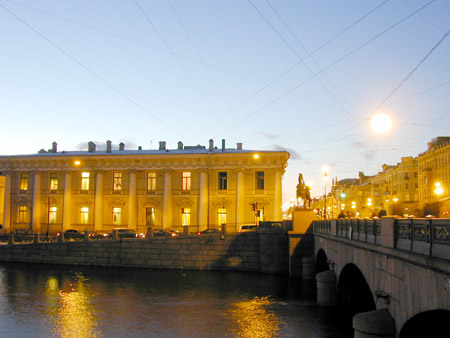
This
structure, based on a design by Giacomo Quarenghi, was added to the
Anichkov Palace in 1803-05. The ground floor was subsequently occupied
by shops.
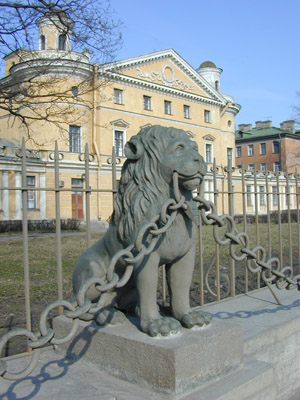
Originally
raised in the 1770s as the summer house of Prince Alexander A.
Bezborodko, the mansion was reconstructed in 1783-84 under supervision
of Giacomo Quarenghi. Upon Bezborodko's death it passed to Count
Grigoriy Kushelev-Bezborodko - man of letters and patron of art. A
tuberculosis hospital has been allocated here after the revolution.
Address: Sverdlovskaya Embankment, 40
Nearest metro stations: Tchernyshevskaya, Novocherkasskaya
Location:
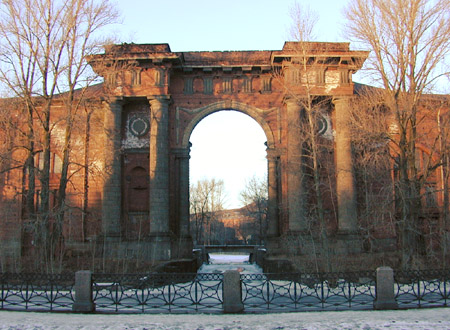
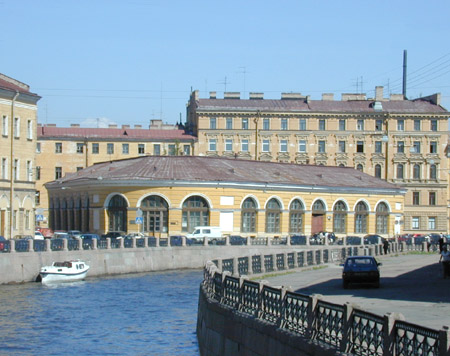
New Holland Arch
The arch, built in 1779-87, forms a part of the walls surrounding
New Holland isle. 300 years ago the plot was used as a lumber-yard of
shipbuilding wood. It is still occupied by the Navy stores, military
institutions, and commercial enterprises.
Architects: Savva I. Tchevakinsky, J.-B. Vallin de la Mothe
Style: Early Neo-Classicism
Address: Moika Embankment, 107
Nearest metro station: Sennaya
Location::
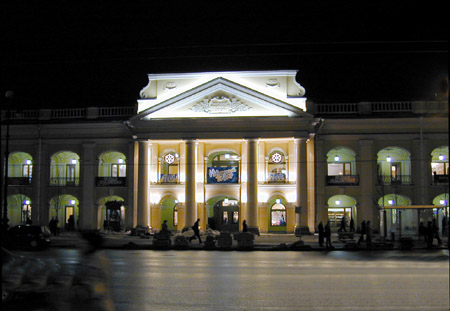
Merchant Court
Gostinyi dvor, or
the Merchant Court, is another work by Jean-Baptiste Vallin de la Mothe.
It was built in 1761-85. The complex houses a large supermarket, several
coffee bars, and a metro station.
Style: Early Neo-Classicism
Address: Nevskiy Avenue, 35
Metro station: Gostinyi dvor
Location:
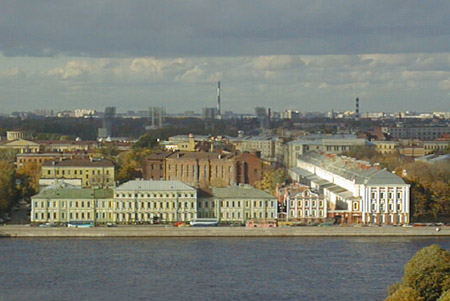
St.Petersburg State University
The university is housed in three Petrine baroque buildings:
1) Twelve Collegia building (1722-44), designed by Domenico Trezzini
for various government bodies;
2) the palace of Peter II (1710-14, 1759-61), also by Domenico
Trezzini;
3) the dean house (1794, 1840-42), by A.F.Schedrin.
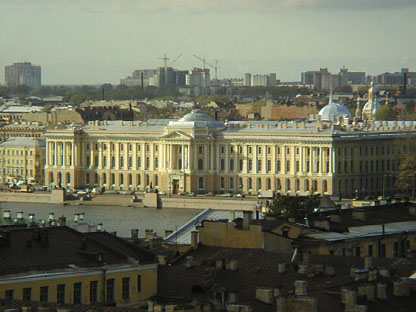
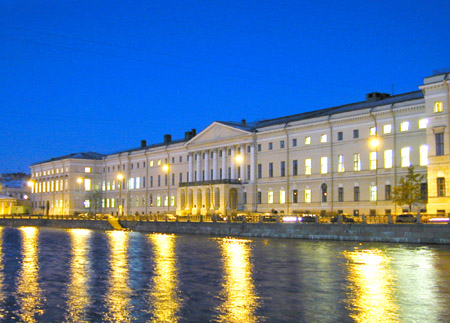
The edifice, constructed in 1804-07 to a design by Giacomo
Quarenghi, used to house an elite educational facility for women.
Nowadays it is occupied by the musical and press departments of the
Russian National Library (formerly known as the State Public Library).
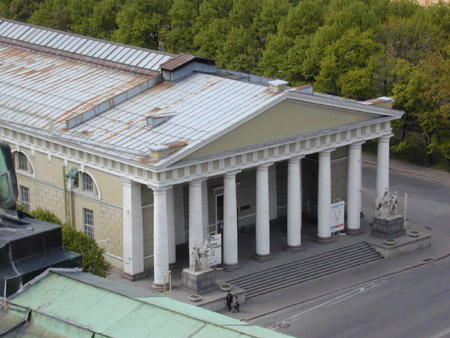
Manezh (or the riding hall) was built in 1804-07 for a regiment of
imperial horse guards. Some exhibitions and shows were held there
shortly before the revolution. The building, for many years used as a
garage, was finally designated the Central Exhibition Hall in 1977.